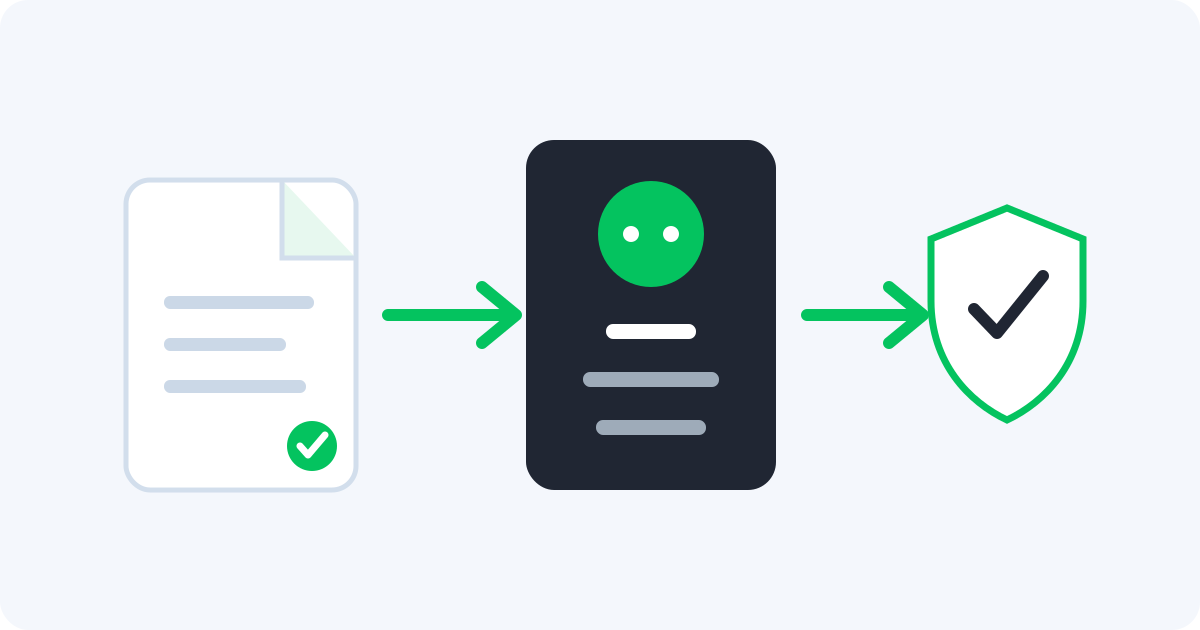
CRM People is a small senior advisory firm. We help large companies prepare and lead CRM and Salesforce transformations, bringing in trusted specialists where needed.
We still have more administration than our size might suggest. Each month we process consultant timesheets, verify purchase orders and rates, and prepare billing inputs. An AI agent now performs much of this work.
Necessary work with little added value
The same process repeats at month end: collect timesheets, assign the correct purchase order and rate, prepare the billing summary, and reconcile consultants' incoming invoices.
None of these steps is difficult. Yet one incorrect purchase-order number, swapped rate, or missing timesheet can cause an invoice to be rejected and delay payment to both us and the consultant.
An agent working from written rules
We did not build an expensive bespoke system. Our AI agent, built on Claude, works with corporate email and the working documents containing purchase orders, timesheets, and the rate card.
The most important component is a simple text document called Billing preparation rules. It explains the process as we would explain it to a new colleague:
- where to obtain the timesheets for the period;
- which single source contains the valid rates;
- the exact structure of the billing input;
- how to communicate with each consultant;
- which checks to perform before returning the result.
We can ask the agent to “Prepare September billing”, and it finds the inputs, processes the timesheets, calculates the amounts, and produces the billing summary.
When the agent must stop
If AI merely calculated faster than a person, the benefit would be limited. The important design decision was to define situations in which the agent must not continue without confirmation:
- the hours cannot be determined unambiguously from a timesheet;
- a consultant's timesheet is missing;
- the reported time is unusual;
- a purchase order or rate cannot be assigned with confidence;
- different sources contradict one another.
Before returning its output, the agent completes a checklist covering purchase orders, rates, calculations, consultant coverage, and mandatory inputs.
Its non-responsibilities are equally clear. It does not issue invoices or send anything to clients or consultants. It prepares the inputs and draft messages for a person to review and send. We remain accountable for the final decision.
The same pattern works elsewhere
- Corporate security and GDPR questionnaires. The agent drafts answers from approved internal policies, agreements, and other documents; we verify the result.
- Contract documentation. It prepares draft statements of work and amendments from approved earlier versions.
- Incoming invoice checks. It reconciles consultants' invoices against timesheets, agreed rates, and purchase orders.
In none of these cases does the agent decide on a commercial or legal commitment. It prepares information, checks consistency, and highlights exceptions.
What we learned
- Rules matter more than the prompt. A maintained procedure works better than a new clever instruction every time and also documents the process for people.
- One source of truth limits unwanted creativity. Valid rates exist in one designated location.
- “Stop and ask” is a feature, not a failure. A well-designed agent does not complete a task at any cost.
- Checks must be part of the process. Define not only the output but also how completeness and consistency are verified.
- Automate external action last. Sending a message, issuing an invoice, or creating a commitment still requires a human decision.
Why this matters for CRM
An AI agent is useful not only because of the language model behind it. It needs good data, a clear process, authoritative sources, appropriate permissions, checks, and explicit limits of autonomy.
The same principles apply when agents begin acting inside CRM. Only the scale and potential consequences change. That is why we first test agentic ways of working on our own processes — with our own rules and our own accountability.